Friday, August 2, 2019


SPEAK FOR THE LAND

 
Temples
     of sacred rock
Templates
     of sequestered ravines
Treasures
     of seasonal rendezvous
Turning turbines
     of sandswept rollers
Timeless troves
      of surrounding riches.

 
Memories
     of quaint chronicles
Monuments
     of quiet cathedrals
Mosaics
      of quixotic colors
Majesties
      of quivering columns
Measures
       of quaking choices.

In honor of Terry Tempest Williams who does speak for our land


Thursday, June 13, 2019

Honoring Anne Frank's 90th Birthday Week with a view from her window in the Attic of her family's Annex hiding spot

Wednesday, March 20, 2019


MEM FOX: COURIER FOR CHILDREN
SHARING WORDS TOGETHER
 

Touches of
            hands held
            hugs given
 
Smiles for
            bursting energy
            bountiful giggles
 
Nods of
            sparkling affirmation
            total interaction

 
Positive, protective
Peaceful, plentiful
Prayerful.


Wednesday, January 30, 2019


HARRIET POWERS: COURIER THROUGH THE CENTURIES
 
I was late getting back to our Washington D.C. family tour bus in 1997.  With toddler age, wiggling grandchildren, my own children were not happy with Mimi holding up the bus.  But I had been held in total amazement by the Smithsonian Institution Quilt Collection Show, especially Harriet Powers’ Bible Quilt.  

During her slave years and beyond, she had pursued and persisted in creatively designing a Bible Quilt with metaphor, alliteration and scraps.  As Jan Richardson in The Mysteries of Making, points out “Powers quilts are not the size of typical bed covers; they are significantly wider than they are long.  This fact, together with Power’s own words about her work, suggests that she created them as a form of proclamation.” (Richardson, p. 216)  Quilts were her platform for speaking her mind and displaying deep knowledge of the Bible.  

“The little we know about Harriet Power’s life reminds us of how the histories of so many women have disappeared. It reminds us too that mystery always attends the process of making. No matter how much we may know about an artist, what an artist creates can never be fully explained.  This is both a gift and a challenge of the creative process: there is a tension between what is revealed and what is concealed.”  (Richardson, p 216)

 The Bible Quilt was first displayed at the Cotton Fair, most likely the Northeast Georgia Fair, of 1886. It was seen by an art teacher, Jennie Smith who wanted to buy it. Powers said no but four years later contacted Smith and said it was for sale, “ownin ter de hardness of de times” (Smith essay, 1891 in Hicks, 28)

Smith continues in the essay, “After giving me a full description of each scene with great earnestness and deep piety, she departed, but has been back several time to visit the darling offspring of her brain. She was only in measure consoled for its loss when I promised to save her all my scraps.” (Hicks, 28)

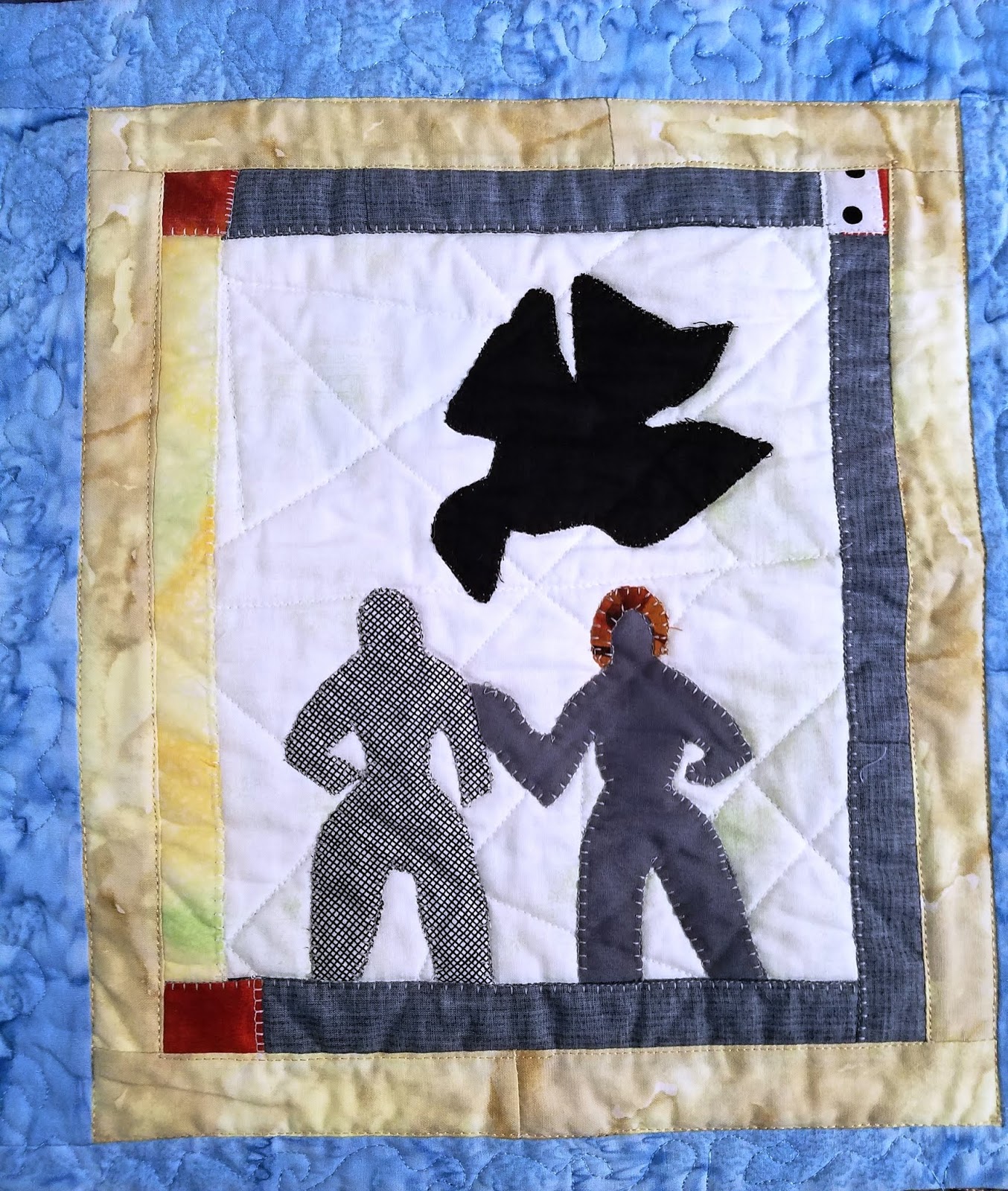
It is through Powers’ scene descriptions to Smith, quilt viewers recognize just how artistically creative and symbolic she was. The square I copied for my Couriers’ quilt, “The Baptism of Christ” has a dove identified by Powers, as the Holy Spirit, descending on Jesus.   Mary E. Lyons in her book, Stitching Stars, says “Doves appear three times in Harriet’s quilts. The dove was also the most frequent bird in slave spirituals because it could easily fly away to freedom.” (Lyons, 15) When Jennie died the man who settled her estate gave the quilt to the Smithsonian. 

Powers designed an even more elaborate story quilt which “is like reading a book of the weather, and real events” (Evans, 25) but even in the Bible quilt on the Judas square,  Harriet describes, “the star that appeared in 1886 for the first time in three hundred years,”(Evans, 16)

The second story quilt went through a number of owners but eventually was donated to the Museum of Fine Arts in Boston in 1964.

Two incidents almost 100 years apart illustrate how misconceptions often infiltrate our American art scene.  In 1895 Jennie organized a display of her student’s art work at the Cotton States and International Exposition in Atlanta, Georgia.  Smith also arranged for the Bible Quilt, which she now owned, to be displayed in the segregated Negro Building.  Clara R. Jemison reported on the fair for Tuscaloosa Times and was particularly taken by the Bible Quilt, “‘Have you seen the Biblical quilt? It was made long ago by a poor ignorant slave who could not read, and whose knowledge of the Bible was the stories told her by other more fortunate.’ Jemison provided no evidence why she wrote as fact that Harriet Powers was poor, uneducated and illiterate.” (Hicks, 30) Not only does Jemison believe Harriet had to have someone else relate and interpret the stories but she just assumes Powers is illiterate. 

Lorene Diver, from Iowa, also was amazed by the quilt at the fair and took pictures, writing descriptions on the back.  She tried to buy the quilt from Jennie but was not successful.  She did however learn Powers mailing address and contacted her. “Contrary to Clara R. Jemison’s published assessment of Powers status, intelligence and literary skills, Mrs. Powers wrote back.” (Hicks, 37) This letter was discovered in 2009 with Diver’s file was opened at the Lee County Historical Society.  In the letter Powers talks about her life, her quilts (more than the two known) and “reading the Bible more than ever.” She ends with “This I accomplish…”(Hicks, 38)

Another much later controversy  began in 1991.   “One of the largest and most important controversies in the recent history of the American quilt community took place when the Smithsonian’s National Museum of American History granted a license for replication of several of their important historic nineteenth century quilts.” (Freeman, 101) The Smithsonian often did this for art artifacts but did not realize to the quilt community “quilts were much more than mere artifacts.” (Freeman, 101)

Reproduction was arranged to happen in China and would allow sales of 200 to 500 quilts which was at most one third their cost if handmade in US.  Harriet Carter, founder of Quilter’s Hall of Fame (1979) helped organize a grass roots and letter writing campaign with copies sent to the Washington Post.  (The Post had originally posted an article on the project.)  After meeting with Mrs. Carter the Post responded to these actions with a second article titled “The Quilts that Struck a Nerve,” with a sidebar to the article called “A Bible of Black History” with a picture of Harriet Powers and her quilt.

Protests (with women draped in quilts) and many meetings were held between the quilt community and the Smithsonian.  “Two issues dominated the controversy: the first was mass reproduction of the quilts; and the second was having the work done in China. However, the whole matter might have gone unnoticed if not for the inclusion of the Harriet Powers quilt…which seems to have been regarded as a kind of living treasure and therefore invested with a sacredness one doesn’t normally associate with conventional art objects.” (Freeman, 103)

As a result the quilt community was allowed more access to the Smithsonian Quilt Collection, a major show in 1997, and opportunity for seminars and research.
The “major show” was the one I was totally caught up in, making me late for the bus, but not too late for how a courier with conviction and courage works.


Sources

Freeman, Roland. A Communion of the Spirts: African-American Quilters, Preservers, and Their Stories. Nashville, TN: Rutledge Hill Press, 1996.

Hicks, Kyra E. This I Accomplish: Harriet Powers’ Bible Quilt and Other Pieces. Black Threads Press, 2009.

 
Lyons, Mary E. Stitching Stars, The Story Quilts of Harriet Powers. New York: Charles Scribner’s Sons, 1993.

 
Richardson, Jan.  In the Sanctuary of Women. Nashville: Upper Room Books, 2010.


Wednesday, January 23, 2019


My Couriers Project:

Finding my voice through research, writing, and quilting

In March, 2017, I found myself searching: probing for positive means and methods to express my frustrations, sadness, and desperations as the world around me turned to negativity, sarcasm and sometimes outright hate. My spiritual connections helped: deep talk and prayer through journaling and group conversations with my Companions Spiritual Group and my pastor.  My pastor asked me to think about how I could react with what I had been given with a touch of humanity and humility?  I pondered: “Is God calling me to do something new?”
Jan Richardson in Sanctuary of Women says, “Our experiences rarely contain just one meaning; much more often they contain multiple meanings or deeper meaning that only reveal themselves with time and attention. “ (Richardson, 127)
Perhaps my past was nudging me with new meanings:
  • When I kept a diary/journal affectionately called Mindy through junior high and high school chronicling my stories of angst, happiness, despair and joy.
  • When I constructed a Cathedrals window quilt in1990 with each “window” a different piece of fabric I had used to sew an outfit for one of my children. Each piece of fabric told a story.
  •   When I turned to poetry and journaling as healing therapy and prayer after the devastating loss of my husband, David, in 1993.
  • When I first observed Harriet Powers Bible Quilt in 1997 at the Smithsonian
Numerous events in the last couple of years also illustrated multiple meanings.  In late 2007 I started a Spiritual Quilt Journal (SQJ): writing a spiritual entry and designing a matching quilt square for each month in 2008. At the end of the year I combined the squares into a quilt and gave numerous talks to local groups.
In 2012 I used The Artist’s Rule: Nurturing your Creative Soul with Monastic Wisdom by Christine Valters Painter to journal spiritually with fabric asking myself “How do I find my spiritual voice?  How do I merge my passions? What ancient paths should I seek?

In March, 2016, The Flint Institute of Arts held an exhibit “From Heart to Hand: African American Quilts” and I was introduced to Yvonne Wells, who “describes herself as a storyteller first and a folk quilter second, works with an incredibly broad range of images which she classifies as religious , sociopolitical, and picture quilts as well as mere “doodle pieces.” (Just How I Picture It in My Mind,79) Discovering pictures of her quilts, “Yesterday, Civil Rights in the South III” and “The Great American Pastime: Homage to Jackie Robinson I,” changed my perspective of story quilts forever
Later that same year of 2016 I decided to explore more deeply, Jan Richardson, and found again Harriet Powers.  In her chapter, “Mysteries of Making” in Sanctuary of Women , Richardson focuses on Powers and how she interspersed scripture, prayer, interpretation and quilt.
That fall, I gave a presentation to my Companions on Harriet Powers, Valorie Wells and Jan Richardson, a prewrite to my Couriers Project.
All of these events, discussions, and reflective prayers led to March, 2017 when I decided to focus on my Couriers Project. Using as much positive energy as I could muster I would research through deep reading and journaling, write with blog entries and poetry and sew designed quilt squares of women of history and today who have shown deep courage and conviction in the face of their own tensions, troubles, turmoil, and turbulence.  

Sources

Hutchins, Catherine E.,editor. Just How I Picture it in My Mind, Contemporary African American Quilts from the Montgomery Museum of Fine Arts. Published by the Montgomery Museum of Fine Arts, Montgomery, Alabama, 2006.  

Painter, Christine Valters. The Artist’s Rule.  Sorin Books: Notre Dame, Indiana, 2011.

Painter, Christine Valters. Lectio Divina, the sacred art.   Woodstock, Vermont: Skylight Paths Publishing, 2011.

Richardson, Jan. In the Sanctuary of Women. Nashville: Upper Room Books, 2010.


Monday, February 16, 2015

FEELING DIFFERENT


Feeling different resonates.  Getting uniforms would seem to make one more the same.  Hiding differences.  Yet Dad probably meant feeling different than what he and his new buddies sensed as they rode trains to Texas from far off cornfields, distant sky scrapers and fishing docks; feeling different from where they had come, who they used to be.  The uniforms would do that.  Clothe them in the war and a reality of where they were.  Why they were there.  No claim or proof now of who inhabited a tiny apartment just a week ago, who typed railroad requisitions just a month ago, who wrote sports and editorials for the Athenian high school paper just two years ago.   No country kid anymore who couldn’t tell mountains from hills, wanted his wife with him, but not with all these “naked men running from the shower.” (Feb 17, 1943 #5 letter) A uniform and a new haircut; feeling different along with thousands of others, all sensing different together.

How long did the fresh uniform aura and hair length sustain him?  How long before it endured stains of Texas dust, Mississippi sweat and frozen vomit?  How long before he knew he could still hold unto speckles of differences and likenesses which molded him unique, but still cast him as a World War II airman?  Gazing at the “Acres of Cadets” photo, differences are not apparent.  Sameness, precise military meticulousness and minutia resonate.  

In the same February letter Dad discusses “There are some things we have to do that are as nutty as the things I had to do when I took the exam at Kalamazoo.  I have gotten over the little homesick spell I had last night and feel considerably better. Things like that are bound to come I guess and all I can do is just face it.”  Was he able to talk about the “nutty things and the homesickness?”  Were these feelings too different to share? Did he endure it inside himself, alone?   

Feeling different continued to resonate.

Thursday, January 29, 2015

SEVEN ON THE SEVENTEENTH


On the day, February 16, 1943, my father departed by train from Chicago for basic training in Texas he began writing letters to my mother back in Michigan.  There are seven first letters, postmarked at different times, but all the same date, February 17.  Each letter echoes the poignant pleas of a very homesick twenty year old, “…to say I missed you last night would be putting it mildly, but then I have got to face it.  More than me had that homesick look in their eye.”

Mom and Dad were country kids growing up in the southern farmlands of Michigan.  A big trip meant traveling slightly northwest thirty miles to Kalamazoo or slightly northeast thirty miles to Battle Creek.  Now, Dad has left all that is familiar, especially his wife of just a year.

Dad describes these new scenes… “the hills or mountains (take your choice) of Missouri. Rolled across the plains of Arkansas, the oilfields of Oklahoma, went through Claremore, the home of Will Rogers, saw the Will Rogers airport. We went by a huge airplane factory and saw lots of bombers flying around…”

After sharing the lower train berth with his card playing new buddy, Herb, and “waking up about six times” he continues… “Well this is Texas—rolling plains and ranch homes, little old shacks that look 100 years old… we just passed a field of Texas Longhorns.  There is a lot of cactus.”

Each letter is a new chapter… “Well, this is San Antonio—wow!!!---they piled us all in a truck---had a physical---our names were taken---chow---marched to barracks---Herb and I bunk together---cut cards for upper or lower. I got the upper… I have your picture all set up and darling you sure look sweet to me.”

Millions wrote letters home during World War II. Today emails more instantly gratify spouses, sweethearts and those on modern battlefields. These communications can’t conquer loneliness, lost time together, or death.  They can, however, endow a daughter with specifics to shape a memory of just what it was like to be her father.  Seventy two years later the sentences surround me with a cascade of images I savor.  He is my father I can now know and touch and feel and love through these pale photos, yellowed scrapbooks, and brittle letters.


Friday, June 27, 2014

The Story of the Dancing Clothesline


The blank wall in the laundry room at Baldwin Center baldwincenter.org stared back at Ruby and I the first day of the ARM (Adult Righteous Mission) trip.   Each year Clarkston United Methodist clarkstonumc.org  members and friends conduct mission trips to centers of help in the surrounding area.  This was our second year at the Baldwin Center whose mission is to “Feed, Clothe, Educate, Empower.” And they do.  

Off the dining room where Baldwin Center serves over 60,000 meals each year to the surrounding Pontiac neighborhood, is the laundry room/restrooms with showers.  The laundry room has multiple washers and dryers which are available free for families and individuals. We were asked to paint a laundry line on the two blank walls to brighten the room.

The first two days we were a little apprehensive as our emerging laundry line seemed not to fit the requested vision.   “I thought it was going to be like a real laundry line: straight lines with towels and sheets and sox.  Easy and quick.”  “Where are the clothespins and poles?”  But we kept painting our joyful laundry line with a meandering, almost dancing, rope and colorful clothes:  mostly kids’ garments like party dresses, jeans, tee shirts and baby onesies.  

By Wednesday the comments turned to compliments which made Ruby and I feel good.  BUT more than the compliments, the clothesline seemed to inspire and induce stories by those who came through to do their laundry or use the restrooms.   The twisting rope of the line connected all of us as they related delightful stories bringing grins to their hungry, worn faces and transforming our tired faces into happy smiles.

Teen aged Rosa and her mother trudged in with huge bags full of laundry.  While their clothes cleaned, they sat and waited and watched us. “You’re keeping us from going crazy sitting her all this time,” Mom declared.   Then she pointed to a pink party dress, “Look Rosa.  You had a dress just like that only yours had a lacy collar.  I loved that dress.”   Rosa replied, “YOU loved that dress!” Smiles from all of us.  Laughter from Mom.

One fellow, on his way to the shower, stopped twice to tell us about his niece who was an artist and “could draw anything.”  “She did a Sponge Bob underwater scene for her autistic brother. He loved it.”

Another guy scared us a little when he said he could bring in his cans of spray paint to help us. But then watching our faces, he explained his family contracted to do graffiti like signs for neighborhood restaurants.

But two little girls melted us.  They stood watching, holding hands, obviously on their way to the restroom.  “Can we help paint?” They asked.  I assured them I would find some white paper for them when they finished in the restroom.  When they came out, the youngest waved a long clean sheet of white toilet paper.  Her sister announced,  ”We found some paper!”  Dad came in just then to take them to waiting lunch.  I hope they get to paint pictures soon.

The stories didn’t last long. Our encounters took minutes.  But on a mission trip, what matters is finding and relating real life stories.  It’s those stories which remind me of the storytellers’ lives: I see the storytellers; I hear their voices once again.  I pray for more happy moments for them, as they have given me.

Tuesday, April 15, 2014

LOVING AWE


Let my whole being bless the Lord!
Lord, my God, how fantastic you are!
You are clothed in glory and grandeur!
You wear light like a robe;
You open the skies like a curtain.
Psalm 104:1-2


I again wake deep into the night: this time as my husband, Tim, murmurs, “It’s happening;” this time it’s on the Florida Gulf with the surf echoing Tim’s call.  Awaiting in awe on our balcony we observe the earth’s shadow creep across in front of the moon.  A blood red moon with swirls of crimson and cinnamon finally stares back.  Magnificent.  God, the Artist, you’re at it again.

I thought it was enough to discover olive shells with intricate chocolate shadings, to jump with joy as a child shares her sand creation, or to follow dolphins’ twisting shadows just beneath the water’s surface, hoping to catch their silver shine as they leap high above the surf.  But God continues searching through his splendors to share with us.

Could there be anymore?  Of course.   It’s Holy Week.  The Lunar Eclipse echoes with a deeper symbolic splendor.  Just as Jesus’ dark horrific death blocked out some of God’s Light temporarily, the moon, too, was blocked temporarily by the Earth’s dark shadow. 

Adam Hamilton is pastor of the Church of the Resurrection in Overland, KN.  His church was rocked by the three violent deaths in that city, two of whom were church members.  He said, “Easter suddenly seems so much more important to me and for our church and community this year as we remember on that day that neither evil, nor hate, nor even death has the final word in our lives. “

Blocked temporarily, God’s magnificent love is still handed out by Him

Monday, February 17, 2014

THAT KIND OF WINTER


I awoke at 1:06am with a start.  At first I thought it was morning.  The full moon cast bright bleached white light through the windows of my northern Michigan home with such abundance I thought for sure the sun had taken over. Forming deep shadows in snow, creating withering white twists and turns on the laden pine branches, I lost my breath to its beauty.  It’s been that kind of winter in Michigan.

 
For the last couple of years when someone complained about minimal flakes falling, or the need for knit hats to cut the chill, I always responded, “But it’s good for the Great Lakes lake levels, harshly low and receding yearly.”  This year with so much of our beloved Lakes frozen over, even the national news is echoing the cries of those who closely observe the Lakes in our front yards. Scientific explanations cite slower evaporation shutting off lake effect snow and ice, serving as fish egg protection from predators.  Nature lovers talk about crystalline scenes and exploring now accessible ice caves.  Driving along Grand Traverse Bay ice fishermen hauled sleds to favored fishing spots,  sweepers formed hockey and skating rinks, and crazy ice kite flyers hung on for dear life as they whooshed and whisked with the wind.  And even the wolves of Isle Royale are happy as their years of seeing and mating with the same wolves might be over with Lake Superior ice allowing them to travel to different mating grounds or even new wolves discovering them.  It’s been that kind of winter in Michigan.

 
Buried deep in life’s depression or the chaos and clutter of normal living, it is often hard to dig out: to reach the level where star bright crystals shimmer and shudder.  Oftentimes it isn’t in the middle of a frosted February or a mud deepening March.  It’s just the day or circumstance itself.  But then the moon wakes you to beams of beauty, you hear about wolves with new girlfriends or you catch the wild Bay wind of exhilaration and you know without a doubt, life will be good and pure again.  It’s been that kind of winter in Michigan.


Friday, November 22, 2013

Then and Now


I slumped on a comfortable coach in the library at Alma College yesterday; observing one student tap on his laptop, another flip through a thick reference book, while I scanned framed posters of guest poets who gave readings in the last year’s poetry series.   50 years ago I tiptoed through mud or balanced on hastily thrown plywood planks set up over icy puddles where the library now stands.  The 1964 Scotsman, the Alma College yearbook, opening page displays a picture of the library construction with this quote written across a tilted metal beam, “Everything That’s Fastened Down Is Coming Loose.”  It did.  Not only for us who were college freshmen, but for the world.

I journeyed back to Alma, wishing to recapture the physical presence of where I stood that Friday afternoon.  Like just about everyone else who is anywhere over age fifty-five, I can immediately recall the sequence of events of my afternoon on November 22, 1963.  The day was Michigan November chill: a damp seeping through your jeans until you feel cold and wet, inside and out.  (Actually, I probably wasn’t wearing jeans.  Skirts to class were still the norm. ) Yesterday the icy air seeped into me again.  But I had to imagine the corner of Old Main where I first observed fellow students with distraught, dismayed looks huddled around a transistor radio.  Old Main burned down in 1969.  I easily found the plaque and stone since I relive the memory of where I was every Nov. 22.  Even with the transistors blaring, we good students still made it into our French lab and dutifully put on our headphones.  But our observant French professor (at Alma the professor ran the lab, not a teaching fellow) quickly realized conjugating French verbs was not going to happen that afternoon.  He dismissed us and as I walked across those wet planks, I witnessed the flag at half-staff.  I knew. 

My world didn’t radically change or transform with the day.  Instead, the confusion and chaos of that week end made everything seem like the moment stood still, being replayed again and again.  Only now, reflecting backward, do I observe the transformation I began: the loss of something sincerely sweet: a security that life stayed fastened down.  Transferring to the University of Michigan the following fall, I witnessed vicious Vietnam protests and read The Feminine Mystique.  Life’s living had indeed come loose. 

Traveling back to Alma I hoped for a profound thought, an amazing revelation about me, about my world, about all that came loose that bitter Friday afternoon.  I found none.  But I did discover once again, reflecting on where I have been to where I am going is an ongoing process: continuing on the continuum of life's good and bad.

On page 172 of the 1964 Scotsman are sepia images of that Friday afternoon.  The only words are, “for a moment even the ‘human chaos’ stopped…then life went on just as before--- almost…”


Thursday, August 22, 2013

THREE DAYS


DAY ONE: INDIVIDUAL

Years ago I cheered on my daughter, Beth, in multiple events.  But that was years ago.   Early this summer she announced she was doing the Susan G. Komen 3 Day http://www.the3day.org/site/PageServer in August.   Excited for her and the cause she chose, I applauded from the sidelines when she walked and trained all summer, especially the grueling, hilly, but very scenic, Center Road on Old Mission Peninsula.  I sewed a shirt with signs of support and encouragement.  Thrilled to interact once again, I drove to Novi, MI, very early on a Friday morning for the Opening Ceremony in my self- assigned role as designated sideline observer and cheerleader.

And each walker started their first twenty miles.

I had no idea.  No one can just be an observer.  Standing near Beth, Leah, and Brenda, all designated walkers, and hundreds of others at the Opening Ceremony, the excitement and dedication surrounding finding a cure for breast cancer permeates your being.  You are not just in the moment; you realize what is happening: we are all one in the fight.

That day in my car, I chased pink butts on walking trails, sought out cheering stations offering thunder sticks (long, narrow pink balloon like cheering apparatus), allowed a man with a pink tutu to stop traffic for me and followed a “Tit Mobile” who seemed to have some idea where the next cheering station would be.  After an hour and a half of “learning the ropes” I drove crosstown to pick up granddaughter, Claudia, so she could share in all the fun.  We found the man dressed like Santa in a pink beard and pink short shorts and knew her mom and Leah were close behind.

And the each walker kept trudging their first twenty miles.

Claudia and I were giddy with excitement.  We knew we would have to “ramp up” our cheering for Day Two so we shopped at Target and Michaels to outfit ourselves in pink boas, pink tiaras, cute pink straw hats from the little girl department (on sale too) pink wands and of course supplies to create posters and shirts.

DAY TWO: COMMUNITY

Walkers started on their second twenty miles

Claudia and I recruited friends and family to join us and we followed pink vans and waving thunder sticks once again.   We even urged my very straight engineer husband to don a boa and tiara and pound especially hard on his thunder stick.

In Plymouth, MI, enthusiastic supporters filled the streets, burst the downtown park.  The park fountain overflowed with pink tinted water.  And I thought of my friend, Betty who died of breast cancer ten years ago.  She lived in Plymouth and I knew she was loving the community support.

And the walkers held on to each other, lifted each other up and kept walking their second twenty.

Later that evening at the camp, we saw acres of pink tents, heard inspiring stores of survival, and intermingled with tired, blistered walkers; hugging them tightly, cheering together.

DAY THREE: HOLY GROUND

And the walkers began their last twenty

Before I chased the walkers on Sunday I heard a sermon from our new Director of Community Outreach at Clarkston United Methodist Church, Mary Gladstone-Highland, who discussed different vignettes of community involvement:  Moses in the desert, the deaf, refugees; and how they were all examples of “Holy Ground.”  Afterwards, I told Mary I felt the 3 Day was also a model of Holy Ground. http://www.clarkstonumc.org/

How little I knew how much.  Driving to catch up with the walkers, I was halfway there when Beth texted me.  Pulling into a Livonia neighborhood, to stop and read, “60 miles! Done!!!!!”  Wow!!! And I hadn’t even made it to Dearborn yet.

Wheeling into Ford World Headquarters after observing weary, but determined walkers still trudging, I tiptoed among exhausted walkers who were also tiptoeing in footies, flip flops or fatigued feet.  I waited with Beth and Leah under a huge shade tree for the inspiring closing ceremony.

It was then that I knew Day Three was about even more:

I watched a man push a woman across the grass in a wheelchair.  I had seen them often on the trails the last three days.  The woman was extremely pale, trembling thin with a headband and hat covering her head, showing exhaustion even when she tried to lift a water bottle to her lips. She was surrounded by children handing her flowers, adults patting her shoulders.  I know only the story I observed;  but I know she was on Holy Ground.


Friday, June 14, 2013

MY DADS


On Memorial Day we visited four cemeteries honoring beloved relatives.  At three grave sites I stood in awe and reverence as I remembered the three men who most influenced, loved and shaped me. 

I never hugged my father, Art.  His B-24 was shot down before I was born.  But I have spent my life searching for him: what he was like, his joys and loves, his talents and treasures.  I have molded my personality around what I have discovered.  I continue to carry on connections and discern directions I believe he would approve. 

 
Growing up I thought I was the unluckiest person in the world.  My friends vacationed in different states.  I got stuck in a rented cottage up north on a fishing lake.  I sulked a lot growing up.    And I blamed my parents, especially my step dad, Bill.  He was incredibly patient with me.  He asked little and loved big.  I never appreciated just how hard it must have been to be a dad to me.

 
Before my mother remarried she and her sister lived together, sharing me, sharing responsibilities, mixing baby-sitting and dating.  When my aunt started dating my Uncle Bob, he shared me too!  Throughout my life he was a steady, happy presence, encouraging me often not to take myself so seriously; melting my grumpiness with humor and hugs.

 
Art, Bill, and Bob. Three men of the Greatest Generation.  I honor them this Father’s Day.


Friday, April 26, 2013

SILENT STORIES

I journeyed into my northern woods this late April morning seeking Spring.  Having departed to downstate a month earlier surrounded by heavy white drifts and swirling snow I hoped spring had finally crept into the forest, if not spring in its full magnificence, at least signs of spring.  Not so, not yet.  A few brave green shoots poked through the brown oak leaves.  My beloved sugar maple did display tiny buds and of course the soft white pine whispered, “See I never deserted you all winter, I am still here.  Green and glorious.”

But my disappointment was short lived  when I buried my anticipation. I stuck my hopes for trillium and morels in my pocket and I just looked.  As Wendell Berry says in his poem, “The Thought of Something Else,” (Selected Poems, p. 23)
              “or a man can be
                safely without thought
                --see the day begin
                and lean back,
                a simple wakefulness filling
                perfect
                the spaces among the leaves."

I looked up at a broken tree with a wondrous woodpecker hole.   I stared down at monster fungus with multiple eyes staring back.  I jumped slightly when I witnessed another face, this one in a tree stump, laughing at me.  I almost felt sad I couldn’t share these pictures with a group of fifth graders.  What delightful stories they could have fantasized.

 At one point I was angered all over again at the uninvited, pirate wood choppers who ventured into our woods and chopped fireplace logs out of the grandchildren’s “balance beam,”   a fallen tree situated just perfectly for “tightrope” walking and flying off.   But I put anger in my pocket next to anticipation when I observed that the pirates had left the stump with its intricate design which I am positive spelled, “Leave me be.”

Sticking to my agenda, all these natural noticings I would have missed.  Spring is late this year, but the silent stories nature gives us are not.


SPEAK FOR THE LAND   Temples      of sacred rock Templates      of sequestered ravines Treasures      of seasonal ren...